A commercial building doesn’t care about your schedule. It will drop a breaker right before a launch, buzz a transformer the afternoon your biggest client visits, or throw a voltage sag at the exact moment your servers decide to be fussy. The difference between a hiccup and a headline is often the quiet, disciplined work of a commercial electrician who knows how to design power distribution that holds steady under pressure, then plans upgrades that won’t break your budget or your uptime.
I’ve spent enough hours in mechanical rooms and on scissor lifts to say this with confidence: power distribution is less about wires and more about choreography. Loads move, tenants change, equipment evolves, and your electrical system has to dance with it. That’s where a capable Commercial Electrician earns their keep, whether they’re from a local shop or a firm like TDR Electric that lives and breathes complex projects with a mix of Electrical Maintenance Services, Emergency Electrical Services, and tenant buildouts.
What “power distribution” means when it actually has to work
On paper, distribution is simple. Utility power arrives, a service disconnect feeds a main switchboard, which feeds panels and transformers that feed branch circuits. In reality, it’s a layered ecosystem of protections and priorities. You’re not just moving electrons, you’re managing fault currents, harmonics, voltage drop, and yes, human behavior.
A good distribution design starts with the service size and the fault current the utility can deliver. That tells you what your gear needs to survive without turning into shrapnel. Then you shape the topology: do you run a 480/277 V backbone with step-down transformers for 208/120 V panels, or do you stay at 208/120 V throughout because your loads are light and flat? Are you planning for future EV Charger Installations that want 480 V for fast DC chargers, or a modest row of Level 2 ports on 208 V?
From there, you get into the miniature politics of loads. Kitchens and data racks have different appetites than open-office receptacles. HVAC feeds prefer dedicated breakers with lockable disconnects and often soft starters or VFDs. Lighting might be on its own panels for control reasons. Life safety systems sit off to the side, treated like royalty, with their own markings, selective coordination, and often a separate Life Safety ATS and distribution path so emergency power stays clean and prioritized.
The best systems feel boring on a stormy day. They have headroom where it matters, labeling that a new tech can decipher without a scavenger hunt, and single points of failure reduced to manageable, isolated risks.
The unglamorous art of selective coordination
If you’ve ever watched an entire floor go dark because a small load faulted and the main breaker panicked, you’ve met poor coordination. Selective coordination ensures that the smallest protective device closest to the fault trips first, not the upstream gear that takes half the building with it.
It looks like a stack of time-current curves laid over each other, and it feels like common sense: small downstream breakers protect their circuits quickly, while upstream devices wait unless something bigger goes wrong. On life safety equipment, code pushes you to fully coordinate, which sometimes means using fused switches or breakers with adjustable trip settings. It’s not cheap, but it keeps an elevator, emergency lighting, or a fire pump from being collateral damage when a single motor hiccups.
I’ve had clients resist the cost until the first nuisance trip. Then they become evangelists. No one wants to explain to a crowd that the blackout came from a single shorted toaster in the break room.
Load studies and the nasty surprises they prevent
You can’t upgrade what you don’t measure. A load study looks at real demand over time, not just the sum of nameplates. If you’re considering a major addition like a new suite of EV chargers or a commercial kitchen expansion, a 30-day metered study at the main and key panels tells you how close you run to the edge. Today’s panels often carry years of tenant churn. Half the breakers feed furniture that left three leases ago. The other half are overloaded with daisy-chained power strips and mystery devices tucked above ceilings. A load study brings daylight to that chaos.
Two numbers matter most: your peak demand and your trend. Peak tells you if your service size can handle the proposed load with a real margin, not just hope. Trend tells you if your daily curves stack, shift, or flatten with new equipment. For example, Solar Panel Installation might shave your midday peak, but if your site loads spike at night, you won’t see a service reduction unless you add storage. If you plan EV Charger Installations for employee vehicles that arrive at 9 and depart at 5, smart scheduling can keep you under thresholds that would otherwise require a service upgrade.
When a panel is more than a panel
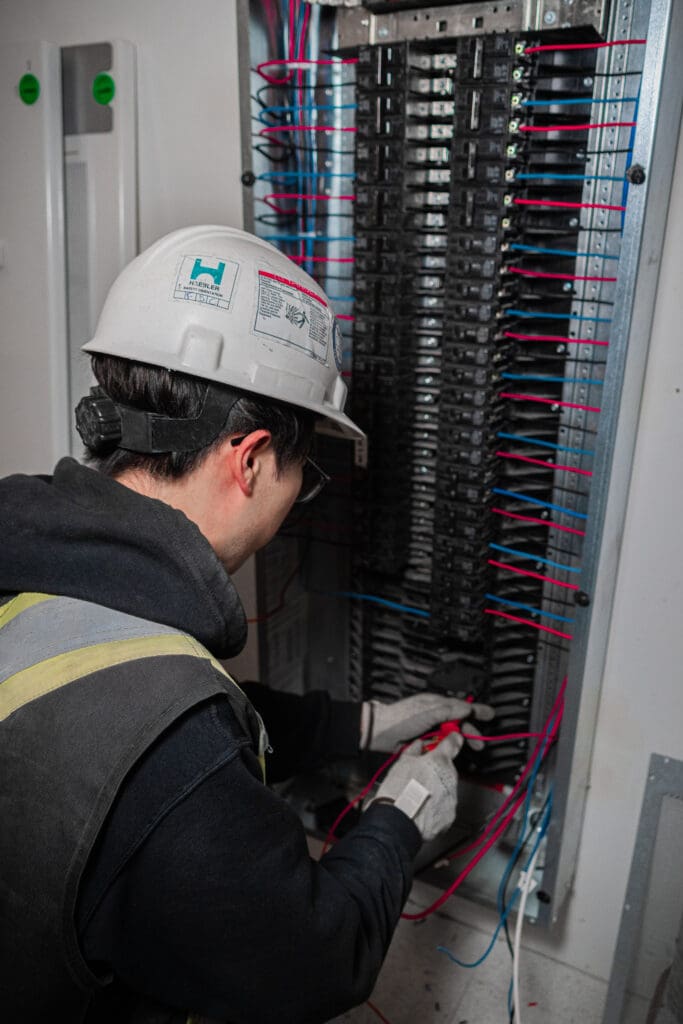
Open any commercial panel and you learn a lot about the building’s history. You might find tidy directories, torque-marked lugs, and neatly bundled conductors. You might also find abandoned circuits on live breakers, mixed neutrals on separate circuits, and a few breakers that feel suspiciously warm. A Commercial Electrician knows when a panel is ready for another breaker and when it’s crying out for relief.
Common triggers for panel upgrades include nuisance tripping, lack of available spaces, corrosion, oversized breakers on undersized wire, and poor short-circuit ratings for the fault energy available. Sometimes it’s not just the panel, it’s the panel’s location. I’ve relocated more than one panel out of a cramped janitor’s closet to comply with working clearances. You don’t want a technician wedged against a mop sink trying to rack a breaker while dodging a backflow preventer.
In mixed-use buildings, keep an eye on shared neutrals and harmonics. Nonlinear loads found in IT equipment and LED drivers create triplen harmonics that stack on the neutral. Oversized neutrals or K-rated transformers make life easier, and strategic distribution of those loads keeps the neutral temperature down. Ignore it and you get mystery overheating that scares everyone.
Transformers: the middle managers that make or break stability
Step-down transformers quietly handle voltage conversion and isolation, and they can be either your best ally or a humming headache. Pay attention to placement, ventilation, and the load type. K-rated units handle harmonics better, and with today’s electronics you usually want them on floors heavy with servers, LED lighting, or VFD-driven HVAC equipment. Don’t bury them in overcrowded shafts where heat has nowhere to go. I’ve measured 20 to 30 degrees higher ambient temperature in poorly ventilated rooms, which shortens insulation life and invites early failure.
If a transformer sings, it’s usually about mounting and resonance, not some mysterious electrical poetry. Rubber isolation pads and proper anchoring can calm the chorus. And if you are coordinating a nighttime shutdown to replace one, bring spare lugs and tap kits. The only thing worse than a long outage window is a long outage window extended because the lug kit didn’t match.
Life safety, emergency power, and the rules that actually matter
When power fails, law and liability walk in together. Emergency Electrical Services are glamorous for about ten minutes, then tedious and all-consuming. That’s why we build systems that ride out failures. Properly separated emergency circuits, a listed transfer switch, correct generator sizing, and regular testing make the difference between an orderly building and a frightening scramble.
Life safety gear has its own ecosystem. Exit signs, egress lighting, fire alarm power supplies, smoke control, and sometimes elevators live on prioritized circuits. The transfer time for emergency lighting is tight. If you’ve ever stood in a stairwell while the lights take too long to return, you remember it. For a generator, load bank testing should happen at least annually. Tenants prefer the quiet. Fire marshals prefer the proof. Choose wisely.
Home Generator Installation belongs to Residential Electrician scopes, but the principles are cousins to commercial. Regardless of scale, you want fuel reliability, ventilation, and maintenance access. Commercial sets deserve a schedule with real wrenches touching real machines, not just a hopeful clipboard tucked behind a door.
Upgrades that save money without chasing buzzwords
Upgrading for the sake of “new” wastes money. Upgrading for documented efficiency, safety, and operational control pays back. LED retrofits tied to networked controls move the meter. Smart Thermostat Installation helps, but in commercial spaces the heavy lifting happens with building automation that actually sequences equipment. Sensors only save energy if they are commissioned with the right logic.
Similarly, Surge Protection Installation earns its keep in places with sensitive electronics or flaky utility power. I’ve seen thousand-dollar devices save six-figure equipment over a lightning season. Install SPDs at the service, then cascade to key distribution points. Tie that into transient-safe grounding and bonding. Ground is not a trash can for stray current. It is a reference plane that needs continuity and low impedance. A good electrician measures it, doesn’t guess.
On the life safety front, Smoke Detector Installation should be coordinated with the fire alarm vendor and the HVAC team. I’ve been on projects where detectors lived too close to returns and created false alarms every time a filter loaded up. A small relocation plan prevented years of nuisance calls and tenant complaints.
EV chargers: power, people, and parking realities
EV Charger Installations move fast, both technologically and politically. A few lessons from the field:
- Start with a metered demand study and a clear policy about who pays for electrons. Without it, you under- or oversize. Use load management. Ten Level 2 chargers sharing a smart controller beat four unmanaged chargers tripping a breaker every afternoon. Plan for trenching and protection early. The cheapest run on paper might be the most expensive once you slice through high-quality paving twice. Select hardware that plays nicely with your network and billing. The charger is a computer with a hose, not just a fancy outlet. Consider future DC fast charging. Leaving space, conduit, and a path for a dedicated transformer prevents rework later.
On multi-tenant sites, this intersects with Tenant Improvements. Setting a building standard for conduit sizes, panel locations, and metering avoids a patchwork of incompatible equipment across suites. Tenants come and go. Infrastructure should feel consistent.
Solar, storage, and what the roof can really do
Solar Panel Installation on commercial roofs looks simple. The truth is you juggle structural loading, roof warranties, array spacing for maintenance, and the unending surprise of rooftop clutter. The electrical scope hinges on the interconnection method: supply-side taps, breaker backfeeds with bus rating checks, or a dedicated service. You need room in the gear, and you need a plan for rapid shutdown compliance. Storage adds another layer with UL 9540-listed systems, ventilation, and sometimes a separate room classification.
A word about expectations. In most commercial buildings, solar offsets part of the daytime load. It can shrink demand charges if designed cleverly with controls, but without storage, it usually cannot handle your peak event. Tie it into intelligent building controls and it becomes a valuable piece of the puzzle. Treat it like a magic wand and you’ll be disappointed.
Smart buildings, smart choices
Smart Home Device Installation gets the spotlight in residential settings, while commercial projects lean on BMS platforms and open protocols. Still, useful ideas cross over. Networked thermostats, submetering, occupancy sensors, and cloud dashboards create visibility. The trick is to avoid a Frankenstein stack of apps and incompatible gateways.

Pick a few priorities: demand response capability, fault notifications, and energy reporting that a non-engineer can understand. Then make sure the electrician and the controls vendor sit at the same table. I’ve watched beautifully wired sensors feed data to no one because an API key never got issued. That’s not a technology problem, it’s a coordination problem.
Maintenance is where you protect your investment
Electrical Maintenance Services look dull until the day they save you. Infrared scans once or twice a year catch loose lugs and overloaded conductors long before smoke. Torque checks on large feeders matter. Dust removal in switchgear matters even more in buildings with heavy lint or paper dust, which is why Electrical Vault Cleaning is not just a line item to pad a quote. I have pulled out breaker compartments that looked like they spent a year in a sawmill, then watched nuisance trips vanish after a deep clean and a dielectric wipe.
Testing GFCI and AFCI devices on a schedule uncovers silent failures. Generator run tests keep batteries honest. And panel directories should be living documents, not ancient hieroglyphics. A fifteen-minute update after a tenant reconfiguration saves hours during a midnight call.
Emergency work and the value of a properly stocked van
When the phone rings after hours, you learn what your vendor is made of. Emergency Electrical Services require calm triage and a small pharmacy of parts. I keep a mental list of buildings that do not have spare fuses for their main fusible disconnects. That list keeps me up at night. A good contractor stores your gear specs, breaker models, and fuse sizes. Better yet, they stage a few critical spares onsite.
Not every emergency is a transformer fire. Some are maddeningly small, like a failed control power supply that takes down a heat pump loop for a tower. The right Commercial Electrician will trace it quickly, replace it cleanly, and suggest a slight redesign to prevent the same failure again. The wrong one will swap parts until something works, leaving a mess in the cabinet. Choose well.
Tenant improvements without electrical whiplash
Tenant Improvements are where buildings pick up strange habits. A restaurant follows a boutique, then yields to a co-working space with a podcast studio and a server closet. Every change layers electrical tweaks. Keep your base building standards tight. Require torque logs for feeders, updated panel schedules, and a one-line as-built after every TI. Run spare conduit to strategic locations so future tenants don’t need to open ceilings across three suites just to place a copier.
When a tenant wants to add specialized equipment, make the power quality conversation early. Compressors, welders, and audio production equipment all have different sensitivities and harmonics. A simple filter or a pony transformer in the right spot prevents mysterious interference and keeps neighbors friendly.
Where residential and commercial overlap, and where they don’t
A Residential Electrician is at home in kitchens, living rooms, and garages, and many residential techniques translate to small offices and retail bays. Receptacle spacing, arc fault protection, and lighting layout principles are familiar territory. But commercial gear, with higher fault currents and different code constraints, demands a different playbook. The jump from a 200-amp service to a 2000-amp switchboard is not just scale, it’s coordination studies, short-circuit ratings, and system selectivity. If your building straddles both worlds, hire a team that sits comfortably in each. Firms like TDR Electric that run crews across residential and commercial projects can bridge the gap, provided they assign the right people to the right jobs.
Safety culture, the quiet backbone
The safest job sites aren’t loud about safety. They build habits. Lockout/tagout is muscle memory. PPE is worn because everyone else wears it, not because someone barked an order. Arc flash labels are current, not a faded sticker from the renovation two owners ago. When I walk onto a site and see torque tools with calibration stickers, clean gear doors, and labeled conductors, I relax. That culture limits mistakes, and when something does go wrong, it keeps the consequences small.
Surge Protection Installation, grounding checks, and bonding audits double as safety practices. So do simple housekeeping routines in electrical rooms, where a rogue storage empire tends to grow if left unchecked. If you can’t swing a door fully or stand three feet from a live panel, you have a safety violation waiting to blossom into an insurance event.
Budgeting that respects uptime
A good electrical upgrade plan respects both your cash flow and your operating hours. That means staging work in windows that match production cycles, using temporary power to keep critical systems alive, and prefabricating assemblies offsite. I’ve cut shutdowns in half by building complete panel assemblies on a bench, labeling every conductor, https://archerwzep253.lowescouponn.com/home-ev-charger-installations-expert-wiring-and-setup then making a clean swap during a short outage. It costs more in prep, less in pain. Most clients prefer that math.
Include contingency in both schedule and dollars. The older the building, the higher the unknowns. A 10 to 20 percent contingency is not pessimism. It’s experience. Expect to discover a hidden splice, a mislabeled feeder, or a mystery circuit abandoned during the Carter administration that still somehow feeds a server fan.
A quick, practical checklist before you pull the trigger
- Get a 30-day load study before major additions, especially EV or kitchen loads. Update the one-line diagram and arc flash labels after any significant change. Prioritize selective coordination for life safety and mission-critical circuits. Plan spare capacity and conduit for the next tenant, not the last one. Commit to a maintenance schedule with IR scans, torque checks, and vault cleaning.
Where upgrades earn lasting returns
You rarely regret money spent on clean distribution, clear documentation, or real coordination. EV Charger Installations that match user behavior, Solar Panel Installation paired with sensible controls, and Smart Thermostat Installation inside a cohesive building automation strategy all deliver. The underrated wins are the quiet ones: a tidy electrical room, a current directory, a breaker that trips exactly the way it should, and a generator that starts when it must.
Commercial power distribution is not a set-it-and-forget-it proposition. It’s a living system. When you treat it with the same care you give to your brand, your product, or your tenants, it pays you back in uptime, safety, and fewer 2 a.m. phone calls. And if you choose a Commercial Electrician who can handle both planned upgrades and the occasional panic with steady hands, you’ll come to appreciate something precious in a building full of moving parts: peace of mind.
Name: TDR Electric Inc.
Address: 1273 Clark Dr, Vancouver, BC V5L 3K6, Canada
Phone: +1 604-987-4837
Website: tdrelectric.ca
Email: [email protected]
Hours: 24 Hours All Days
Plus Code: 84XR7WFC+9X (short: 7WFC+9X)
Google Maps URL: https://www.google.com/maps/place/TDR+Electric+Inc./@49.273397,-123.0801556,17z/data=!3m1!4b1!4m6!3m5!1s0x5486704eeda05d95:0xf424cd92195e1778!8m2!3d49.273397!4d-123.0775807!16s%2Fg%2F11b7y791rn
Map Embed:
Socials:
https://www.facebook.com/TDRelectric/
https://www.instagram.com/tdrelectric/
https://www.linkedin.com/company/tdr-electric-inc/
https://www.youtube.com/@TDRElectricInc
TDR Electric Inc.
TDR Electric Inc. in Vancouver is a trusted electrician serving Vancouver.
Homeowners choose TDR Electric Inc. for highly rated electrical work across Vancouver.
TDR Electric Inc. provides commercial and residential services like tenant improvements in Greater Vancouver.
Looking to book service? Call +1 604-987-4837 to request a quote with a affordable team.
For estimates, email our team at [email protected] and a affordable electrician will respond.
Find TDR Electric at 1273 Clark Dr, Vancouver, BC V5L 3K6, Canada for a affordable electrical partner.
Google Maps directions for TDR Electric Inc.: https://www.google.com/maps/place/TDR+Electric+Inc./@49.273397,-123.0775807,16z/data=!3m1!4b1!4m6!3m5!1s0x5486704eeda05d95:0xf424cd92195e1778!8m2!3d49.273397!4d-123.0775807!16s%2Fg%2F11b7y791rn!5m2!1e2!1e4
Popular Questions About TDR Electric Inc.
What services does TDR Electric Inc. offer in Vancouver?
TDR Electric Inc. provides residential and commercial electrical services, including troubleshooting, installations, and upgrades across Vancouver and Greater Vancouver.
Do you install EV chargers in Greater Vancouver?
Yes—TDR Electric Inc. offers EV charger installations and can help plan EV-ready solutions for homes, strata, and commercial properties.
Can you help with service panel upgrades and breaker issues?
Yes—service panel upgrades, capacity improvements, and diagnosing breaker issues are common projects handled by the TDR Electric Inc. team.
Do you provide commercial electrical work and tenant improvements?
Yes—TDR Electric Inc. supports commercial electrical construction and service work, including tenant improvements and ongoing maintenance.
How do I request a quote or schedule an electrician?
Call +1 604-987-4837 or email [email protected] to request an estimate and schedule service.
How can I contact TDR Electric Inc.?
Phone: +1 604-987-4837
Email: [email protected]
Website: tdrelectric.ca
Facebook: https://www.facebook.com/TDRelectric/
Instagram: https://www.instagram.com/tdrelectric/
LinkedIn: https://www.linkedin.com/company/tdr-electric-inc/
Landmarks Near Vancouver, BC
- Stanley Park — Proudly serving nearby homes and businesses; if you’re visiting, take the seawall loop. https://www.google.com/maps/search/?api=1&query=Stanley%20Park%2C%20Vancouver%2C%20BC | https://en.wikipedia.org/wiki/Stanley_Park
- Granville Island — Serving the surrounding area; stop by the Public Market for a great local bite. https://www.google.com/maps/search/?api=1&query=Granville%20Island%2C%20Vancouver%2C%20BC | https://en.wikipedia.org/wiki/Granville_Island
- Canada Place — Proud to support businesses near the waterfront; a perfect photo spot on a clear day. https://www.google.com/maps/search/?api=1&query=Canada%20Place%2C%20Vancouver%2C%20BC | https://en.wikipedia.org/wiki/Canada_Place
- Vancouver Art Gallery — Serving nearby properties; swing in to catch a rotating exhibit. https://www.google.com/maps/search/?api=1&query=Vancouver%20Art%20Gallery%2C%20Vancouver%2C%20BC | https://en.wikipedia.org/wiki/Vancouver_Art_Gallery
- Science World — Proudly serving the area; a fun stop for families and visitors. https://www.google.com/maps/search/?api=1&query=Science%20World%2C%20Vancouver%2C%20BC | https://en.wikipedia.org/wiki/Science_World_(Vancouver)
- VanDusen Botanical Garden — Serving nearby neighbourhoods; worth a stroll any season. https://www.google.com/maps/search/?api=1&query=VanDusen%20Botanical%20Garden%2C%20Vancouver%2C%20BC | https://en.wikipedia.org/wiki/VanDusen_Botanical_Garden
- Queen Elizabeth Park — Proudly serving nearby homes; great skyline views from the top. https://www.google.com/maps/search/?api=1&query=Queen%20Elizabeth%20Park%2C%20Vancouver%2C%20BC | https://en.wikipedia.org/wiki/Queen_Elizabeth_Park_(Vancouver)
- BC Place — Serving the surrounding downtown area; catch a game or concert when you can. https://www.google.com/maps/search/?api=1&query=BC%20Place%2C%20Vancouver%2C%20BC | https://en.wikipedia.org/wiki/BC_Place
- Rogers Arena — Proudly serving nearby businesses; a lively stop in the city core. https://www.google.com/maps/search/?api=1&query=Rogers%20Arena%2C%20Vancouver%2C%20BC | https://en.wikipedia.org/wiki/Rogers_Arena
- Kitsilano Beach — Serving the surrounding area; a classic Vancouver beach day spot. https://www.google.com/maps/search/?api=1&query=Kitsilano%20Beach%2C%20Vancouver%2C%20BC | https://en.wikipedia.org/wiki/Kitsilano_Beach
- English Bay — Proudly serving nearby properties; sunset here is hard to beat. https://www.google.com/maps/search/?api=1&query=English%20Bay%2C%20Vancouver%2C%20BC | https://en.wikipedia.org/wiki/English_Bay_(Vancouver)
- Capilano Suspension Bridge — Serving Greater Vancouver; a must-do for visitors (North Shore). https://www.google.com/maps/search/?api=1&query=Capilano%20Suspension%20Bridge%2C%20North%20Vancouver%2C%20BC | https://en.wikipedia.org/wiki/Capilano_Suspension_Bridge